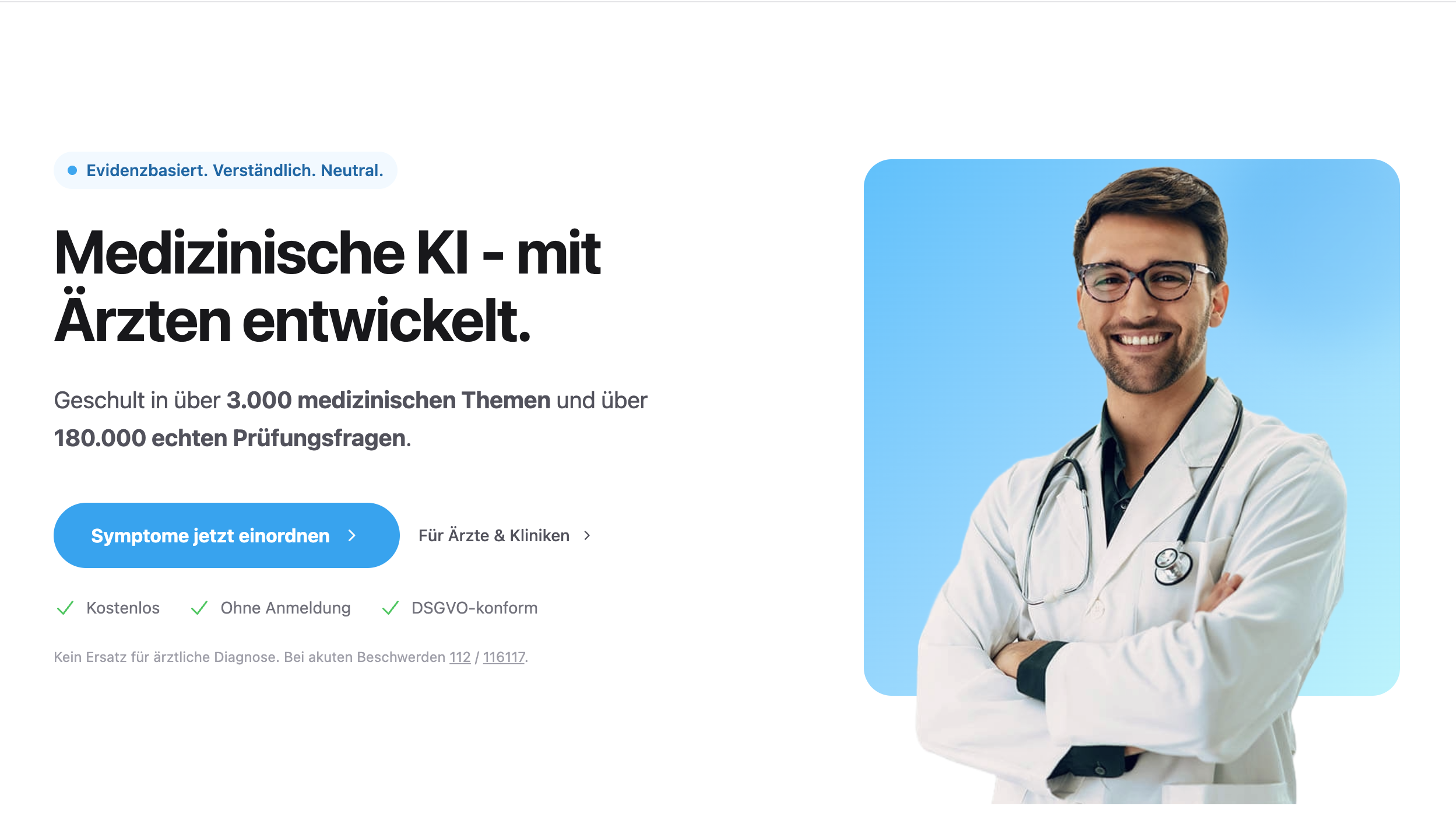
Gesund360 was built around a simple healthcare reality: patients often arrive at appointments anxious, unstructured, and unsure which details matter, while doctors work in a system with too much documentation, too little time, and constantly changing medical information.
The answer was not an autonomous diagnosis bot. Gesund360 was designed as an assistance and orientation layer. For patients, it structures symptoms, asks clarifying questions, explains medical terms in understandable language, and prepares a concise note for a doctor visit. For clinicians and clinics, it supports documentation, information processing, and decision preparation without taking responsibility away from the physician.
The product is free to use, available without account creation, and built with a strong privacy boundary. The public Gesund360 experience states that it does not replace medical diagnosis and directs users to emergency numbers for acute symptoms.
Medical depth
The platform was trained across more than 3,000 medical topics, 180,000 real exam questions, and 35,000 medications. That breadth matters because healthcare AI has to understand symptoms, terminology, medications, context, urgency, and the limits of its own output.
Gesund360 was developed in cooperation with medical doctors so the product could match clinical workflows instead of generic chatbot behavior. The doctors’ role was especially important for quality control: a healthcare AI needs to know what to ask, what to summarize, what to flag as urgent, and where a human physician must take over.
The project also sits in a German medical standards context, including cooperation with the Bundesinstitut fuer Arzneimittel und Medizinprodukte (BfArM). That shaped the product around safety, transparency, and responsible boundaries rather than consumer AI shortcuts.
Built for real healthcare workflows
On the patient side, Gesund360 turns a vague health concern into a structured preparation for a real appointment: symptom duration, intensity, progression, accompanying symptoms, pre-existing conditions, and optional medication context.
On the doctor side, the same structure can reduce friction before consultation. Better-prepared patients and cleaner symptom summaries save time, reduce misunderstandings, and make the first minutes of a visit more useful.
The result is a healthcare AI that is useful precisely because it stays inside its role: it gives orientation, structure, and preparation, while diagnosis and treatment decisions remain with medical professionals.