
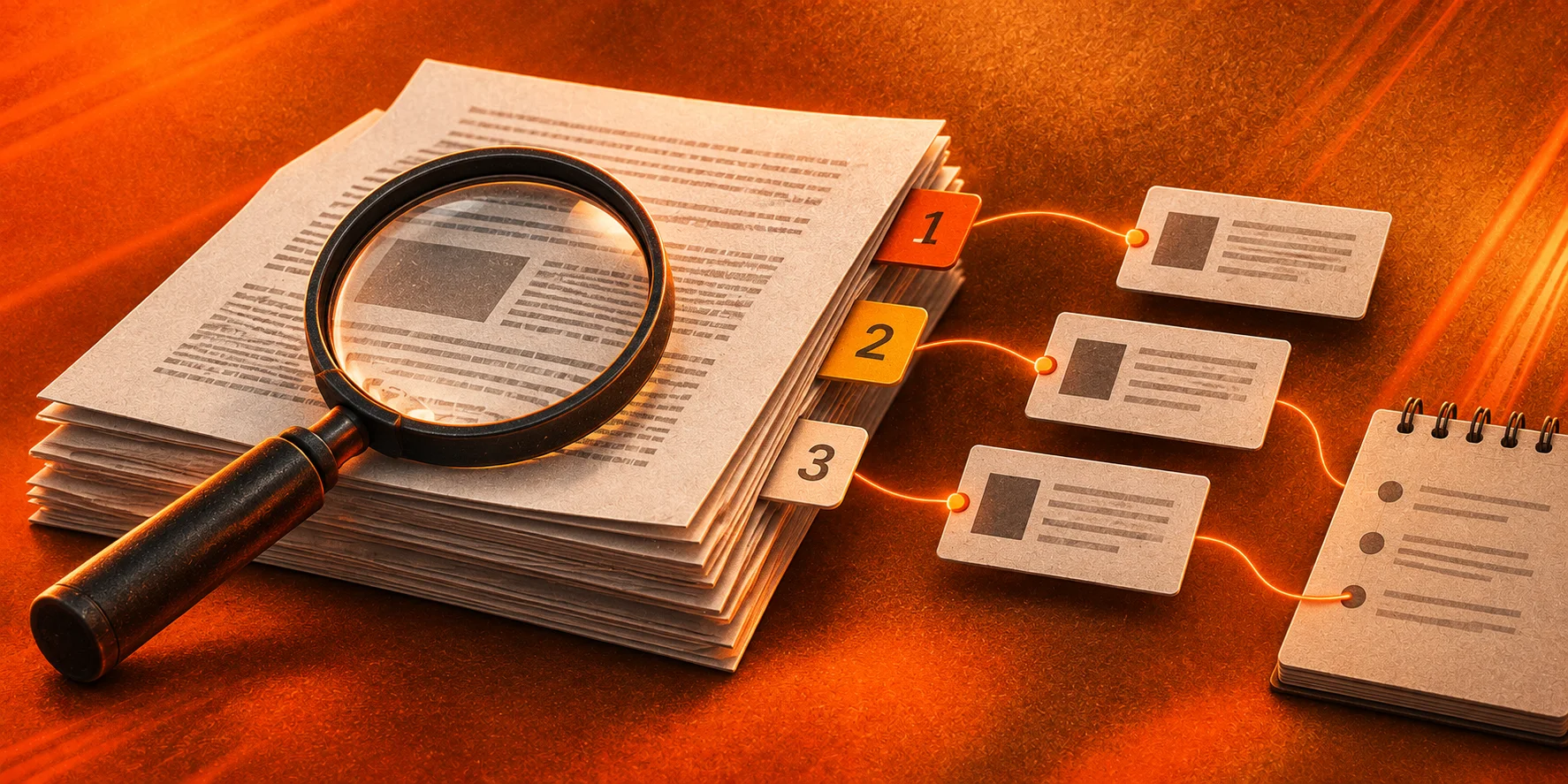
AI can make research faster, but it should not replace the source trail. The useful role for AI is to make a question clearer, bring order to a reading list, and expose where evidence is thin—not to turn a plausible summary into an uncited conclusion.
LLMBase AI Chat can help you search research papers and work with them directly. The workflow below keeps the original work, the reasoning, and the next decision connected.
Work backwards from the decision
Before searching, write a short brief. Include the question, who needs the answer, the date range, the geography or population, and the kind of conclusion you need to make. Add one sentence about what evidence would change your mind.
For example: Which interventions improved first-year university retention in Europe after 2020, and which findings are strong enough to inform a pilot programme?
That is much more useful than “find papers about student retention.” It tells the research process which studies are likely to matter and which are only background reading.
Build a small, inspectable reading list
Start broad enough to understand the field, then narrow the list. Ask for papers by topic, author, institution, year, or open-access availability. If you already have a DOI, title, or paper link, use it to locate the exact work instead of relying on a similar-looking result.
Ask for a reading list that includes:
- Title, authors, publication year, and a stable link or DOI.
- The question the paper addresses.
- The population, method, and time period.
- One reason it belongs in the review.
- A note when the paper is not a direct match for your scope.
Open the most important papers yourself. A title and abstract can help you triage; they are not a substitute for checking what the study actually measured, how it measured it, and how far its conclusion can travel.
Compare studies on the same terms
An AI summary becomes more useful when every paper is judged against the same questions. Make a small evidence matrix rather than collecting a stack of isolated summaries.
| Question | What to capture |
|---|---|
| What was studied? | Population, setting, dates, and sample size. |
| How was it studied? | Design, data source, comparison group, and limitations. |
| What did it find? | The reported result, not a stronger paraphrase. |
| How applicable is it? | What must be true for the finding to matter to your case. |
Then ask focused follow-ups: Which results agree? Where do they conflict? Is the difference explained by the population, method, or outcome measure? Which claim is directly supported by the cited source, and which is an interpretation?
This is where AI can save real time: it helps surface patterns and gaps across a set of papers while you keep ownership of the judgement.
Keep a provenance note as you go
For every conclusion you may reuse, keep the source beside it. A simple research note can have four columns: claim, source, confidence, and what to verify next. It prevents a useful chat exchange from becoming an orphaned paragraph with no way back to the evidence.
Use wording such as “the study reports”, “the authors infer”, and “this may suggest” deliberately. Those phrases distinguish a reported finding from your own synthesis. If a result matters to a thesis, policy, investment, or product decision, read the cited passage before using it.
Prompts that produce better research work
Try a prompt like this:
Find recent scholarly work on [topic] for [population and geography]. Return ten candidate papers with title, authors, year, DOI or link, method, and a one-sentence relevance note. Separate primary research from reviews and flag papers that do not fit the date range.
After selecting a smaller set:
Compare these papers in a table. For each, show the research question, method, key result, important limitation, and the exact source that supports the result. Do not merge conflicting findings; explain the conflict instead.
Turn evidence into a draft without overstating it
Finish with an outline, not a polished certainty. Ask for a central claim, the evidence that supports it, relevant counter-evidence, limitations, and questions still open. Then write the final passage in your own voice with the source material open beside you.
The goal is not to outsource research. It is to move from a vague question to a reviewable, source-aware draft faster—and to make it easy for the next reader, or future you, to check every important statement.